
Project deep dive
The Business Case for AI-Assisted UK Company Due Diligence
Why UK company due diligence is a workflow and evidence problem before it is an AI problem, and where an agentic research system can create practical value without replacing underwriting judgement.
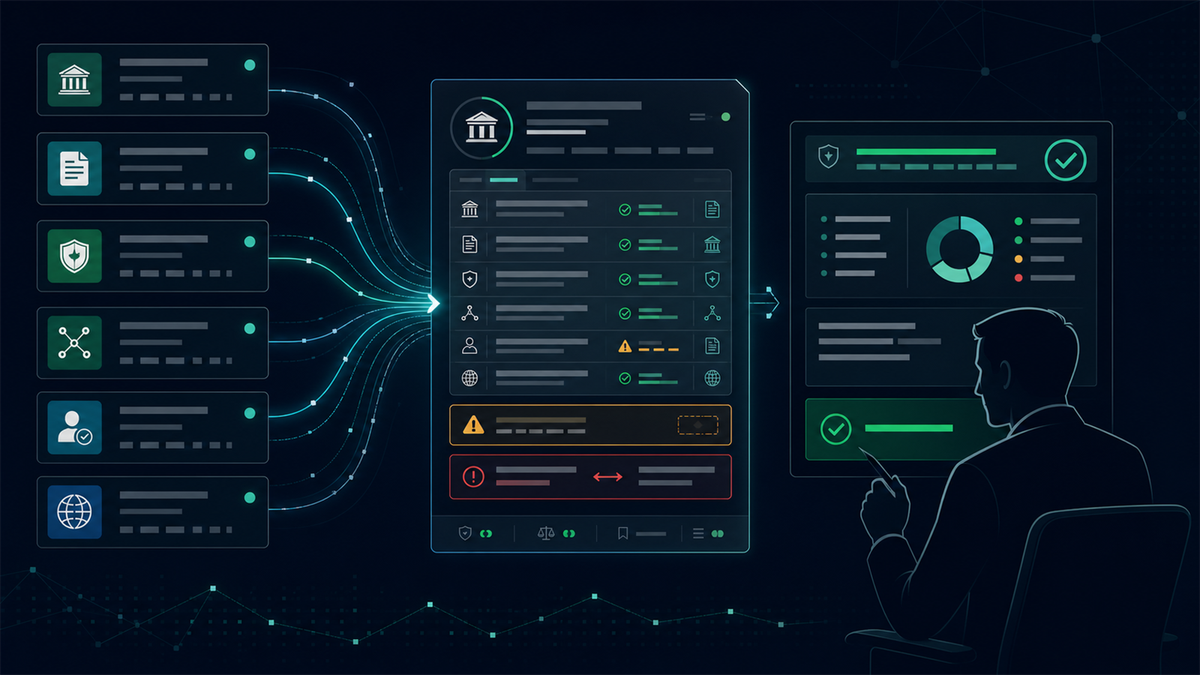
Executive summary
The opportunity is controlled research, not an automated verdict.
UK company due diligence becomes valuable when it turns scattered checks into a consistent, reviewable case: the correct entity, the required evidence, the unresolved gaps, and the reasons a human needs to look closer.
The recognisable scene
Six tabs open, and still no way to tell whether the case is complete.
A request arrives for D&O, Cyber, Financial Institutions, Professional Indemnity, or Trade Credit cover. Before underwriting can begin, someone must confirm the entity, inspect filings, review directors, check regulatory status, understand ownership, and search for adverse events.
The sources are not the difficult part. The operational risk lives between them: deciding whether the company match is correct, which checks are mandatory, which source is authoritative, whether an empty result is meaningful, and how the next reviewer can reconstruct the conclusion.
What the business is buying
A controlled research case that another person can review.
A model-generated company summary is useful, but it is not the operating model. A serious workflow identifies the entity, plans the relevant checks, retains evidence quality, and hands unresolved questions to an authorised reviewer.
Resolve
Confirm the intended legal entity before high-impact checks.
Plan
Select the research dimensions required for the purpose.
Collect
Gather official and public evidence with source context.
Challenge
Expose failed checks, weak matches, and contradictions.
Review
Present findings and open questions to the human owner.
Business principle: AI creates value when it reduces research friction without reducing visibility.
Three failure modes that matter
The most dangerous case is the one that looks complete when the work was not.
Missed checks
Different reviewers complete different combinations of identity, officer, filing, ownership, regulatory, and public-event checks.
False-clean results
A timeout, weak entity match, or incomplete search is later interpreted as though nothing adverse was found.
Weak referrals
A specialist receives a risk label without the finding, contradiction, missing check, or unresolved question behind it.
The evidence-control implementation and its remaining gaps will be examined in a dedicated later chapter.
Where value may appear
Six business hypotheses worth testing in a controlled pilot.
These are intended value areas, not measured claims. Each needs a baseline, a target, and evidence that quality did not decline while the workflow became faster or more consistent.
Faster triage
Measure case-research time against a defined manual baseline.
Consistent minimum checks
Measure required-check completion by product and case type.
Better referrals
Ask reviewers whether the reason and open question are actionable.
Stronger auditability
Measure whether material findings retain source and rationale.
Improved risk visibility
Track material signals missed by the first-pass workflow.
Scalable pre-screening
Measure throughput together with evidence and referral quality.
The full pilot-measurement design is reserved for the measurement and operations chapter.
Handling paths and authority
Use evidence-backed indicators, not one magical score.
A single risk label is too compressed to run a business process. The useful output is a set of findings and handling indicators that an organisation can connect to approved appetite and authority rules.
Quote consideration
No material stop signal in the completed evidence, subject to normal underwriting review. This is not an automatic quote instruction.
Human referral
A material finding, contradiction, uncertain identity, or incomplete mandatory check needs resolution by the appropriate owner.
Potential decline consideration
A serious verified fact may sit outside appetite, but the business defines the rule and the authorised person makes the decision.
Current boundary: the project produces research findings and indicators. It does not issue an approved binding underwriting disposition.
The detailed accountability model will be covered in the human-authority chapter.
Honest limits
A useful reference framework is not automatically a production platform.
The project demonstrates the shape of an evidence-led research system. Several controls still need stronger implementation, calibration, and operational ownership before production use.
Overall confidence remains an LLM judgement rather than a calibrated probability.
Overall risk has no approved deterministic or hybrid aggregation rule.
Missing evidence can still appear too similar to an affirmative low-risk result.
Targeted follow-up query text is planned but not yet executed by retrievers.
The API lacks production authentication, rate limiting, and persistent case storage.
Public-source and sanctions-screening candidates require human verification.
The readiness conversation
Before choosing a model, answer these eight questions.
Technology can coordinate research. It cannot invent your source hierarchy, risk appetite, override authority, or definition of sufficient evidence.
- Which company checks are mandatory for each product or use case?
- Which source is authoritative for each official fact?
- What happens when a mandatory source is unavailable?
- When must uncertain identity stop the workflow?
- Which findings force referral or enhanced diligence?
- Who can override an indicator, and what reason is retained?
- How will confidence and evidence sufficiency be calibrated?
- Which metrics prove value without hiding new risks?
The AI Due Diligence Workflow Readiness Checklist workbook is complete. Subscribe to be notified when its public download page goes live; this signup does not currently deliver the file automatically.
Practical takeaway
The first business win is controlled research, not automated risk acceptance.
A useful due-diligence system helps reviewers reach the real underwriting question sooner, with a visible record of what was checked, what failed, what contradicted, and what still needs human judgement. That is a narrower promise than autonomous underwriting, and a more credible one.
Next chapter: Inside an Evidence-Driven Company Risk Agent will move from the business case into the implemented workflow, typed source routes, evidence controls, retry loop, and deterministic fact handoff.