Agents & workflows System overview
Before you quote a UK company, know what wasn’t checked
An underwriter needs a route and its reasons before quoting a company, plus an honest list of what wasn’t checked. A tool that hides its gaps is worse than none.

• The UK Company Pre-Screen checks a company’s public record before an underwriter quotes, and recommends one of four routes. Written rules pick the route; AI only reads the news and explains.
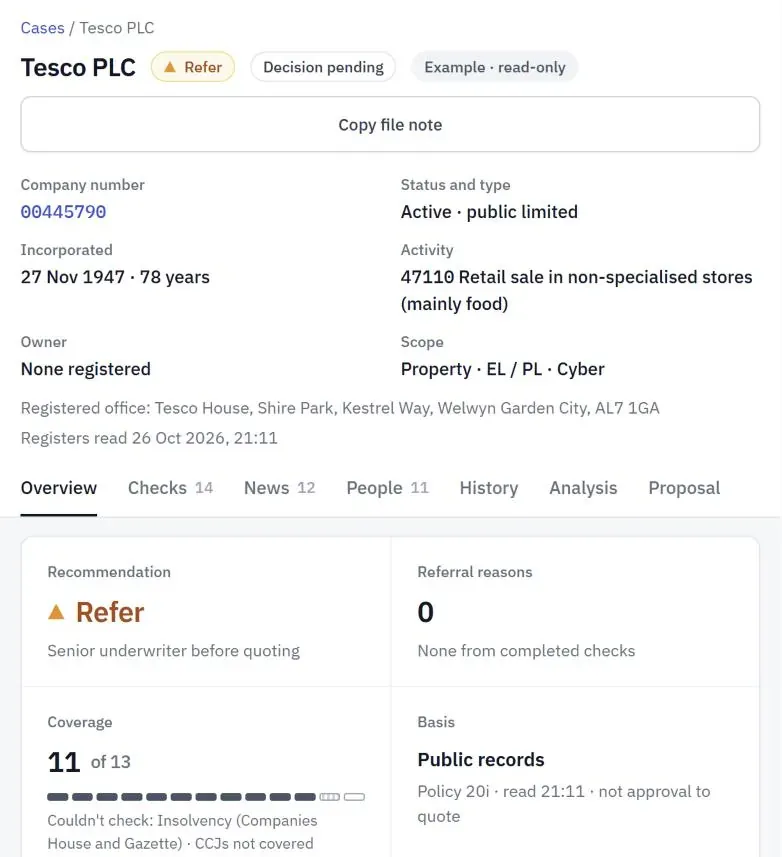
• On 26 October its Tesco case said Refer with zero referral reasons. The reason was the check that couldn’t run: The Gazette refused the demo’s request, so insolvency was unchecked.
• A tool that hides what it didn’t check is worse than no tool. This one names every gap, and a gap in an important check can’t come out better than Refer.
On 26 October I opened a UK company report that seemed to disagree with itself. The company was Tesco PLC. The box for referral reasons showed zero. The recommendation at the top said Refer.
Picture the person reading it. A broker is waiting for a quote. The underwriter needs to know whether to carry on, ask the broker a question or bring in a colleague. A page that says “Refer” gives them another job. It owes them a reason.
The reason was the check that didn’t run
My UK Company Pre-Screen had completed 11 of 13 checks. Two were missing. County court judgments sit in a paid source the demo doesn’t cover, a known gap on every case. The other gap was unexpected: The Gazette, the official source of insolvency notices, had refused a request from the server running the demo.
Under the rules that evening, an insolvency check that couldn’t run meant Refer. The checks that finished had found nothing. The missing check was the reason: whoever picked up the case needed to look into insolvency before relying on the report.
Why a later run can give a different answer
I ran Tesco from home the same evening. The Gazette answered there, the insolvency check completed, and the route was Note only.
On 29 October I changed how the demo handles The Gazette. Its server still couldn’t reach it, so the demo now lists The Gazette as not covered and checks insolvency on Companies House alone. Tesco now comes out Note only there too, but a winding-up petition that appears in The Gazette first could be missing.
Those two “Note only” results mean different things. One run reached both sources; the other reached the sources the demo is set up to use. If I were handing either report to an underwriter, I’d want the date, the sources searched and the rule behind the route on the same page. Deciding what counts as enough coverage is itself a decision worth recording.
How a case works
A person first confirms the company number and address against the proposal, because similar names can belong to different companies. Then the tool runs 13 checks (14 when the proposal says what the company does) on Companies House, The Gazette, the UK Sanctions List, the FCA Register and the news. Each check ends in a stated result, including “couldn’t check”, and written, versioned rules pick the route.
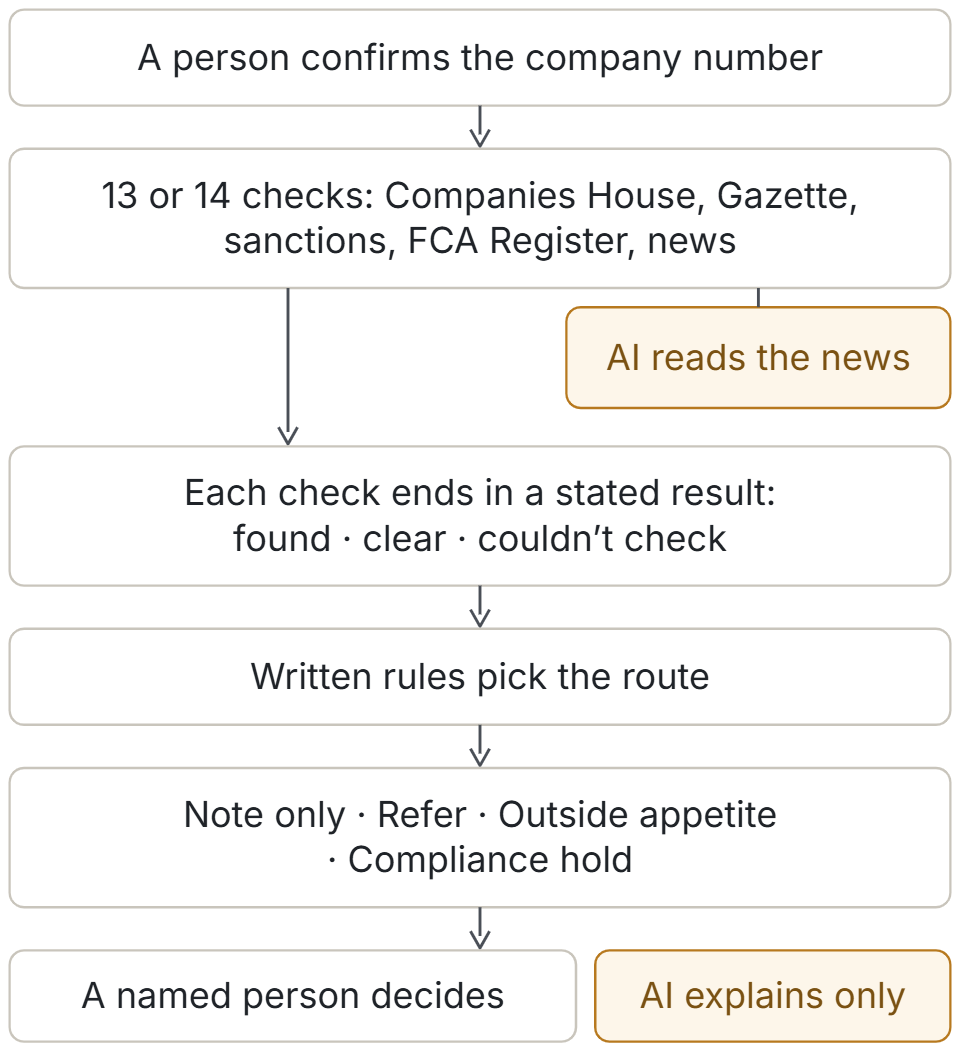
- Note only: read the findings and the coverage, then carry on with your usual process.
- Refer: take the stated issue, or the missing information, to a senior underwriter, or ask the broker.
- Outside appetite: check the finding against your appetite and record the reason for any override.
- Compliance hold: pass a possible sanctions match to compliance before going further.
One model call reads the news, to answer one narrow question: is this article about this company? AI agents can explain a case and draft a question for the broker, through an MCP server whose tools can’t record a decision. A named person records the decision and the reason. These are my draft rules; an insurer would decide which sources it requires and which findings warrant each route.
What nine cases told me
This is a rebuild. My first version was a research agent that decided the risk itself; Version 1 let an AI agent decide. Version 2 lets written rules decide. compares the two. On nine real companies, with the key facts written down before any run and the answers rescored by a separate AI reviewer, the Pre-Screen found all nine. The reviewer also found two wrong statements in its reports, both on Revolut, and both would have mattered to the person reading them.
I changed the rules partly because of these cases, so they’re a development set, not proof. The evidence I’d want next is a set of fresh cases reviewed by a practising underwriter, with their route and reason recorded before they see the tool’s answer.
Limits
- The demo doesn’t cover county court judgments or, since 29 October, The Gazette.
- The routes come from my draft thresholds, not an insurer’s appetite.
- Nine development cases; no underwriter has scored it yet.
- The reason for a gap-driven Refer sits under Coverage, not beside the route. That’s the next change to the page.
The decision behind it
Decision: written rules decide the route; models only read text and explain.
Alternative rejected: an agent that writes the risk level itself, as my first version did.
What it cost: every threshold has to be written down and defended, and the output is plainer than a written brief.
When to revisit: once there’s a history of real referral decisions to test the rules against, or a check needs judgement that rules can’t express.
Code: the Pre-Screen on GitHub (MIT)
Demo: nine real cases, no sign-up · Try the UK Company Pre-Screen yourself
System: how the Pre-Screen works, and what it can’t do yet
Related: Version 1 let an AI agent decide. Version 2 lets written rules decide. · Nothing found isn’t the same as nothing checked
Free: the AI Workflow Readiness Checklist
If you sign off on risk: what would a tool have to show you before you’d trust its “clear”?
First published 29 Oct 2026. Updated 8 Nov 2026: rewritten around the Tesco case and what changed on 29 October. On 7 Nov, version 1’s key-fact score was corrected to four half-credits, not two facts found.
AI engineer with 14 years across machine learning and applied AI: prompt design, document AI, LLM workflows and the review loops that make them safe to ship. I build real systems and write up what breaks along the way.
Get the next note by email
One short email when something ships or breaks. Free.