Systems / UK Company Pre-Screen
UK Company Pre-ScreenUK Company Pre-Screen
A first look at a UK company for a commercial underwriter: written rules recommend a route, and every check that couldn't run says so.
The problem
Before a commercial underwriter quotes for a UK company, they want to know one thing: is there anything on the public record that means I should refer this, decline it, or ask the broker a question first? The answers are spread across Companies House, The Gazette, the UK Sanctions List, the FCA Register and the news. A check that quietly fails looks exactly like a check that found nothing, and a tool that says "clear" when it didn't look is worse than no tool, because the underwriter stops looking.
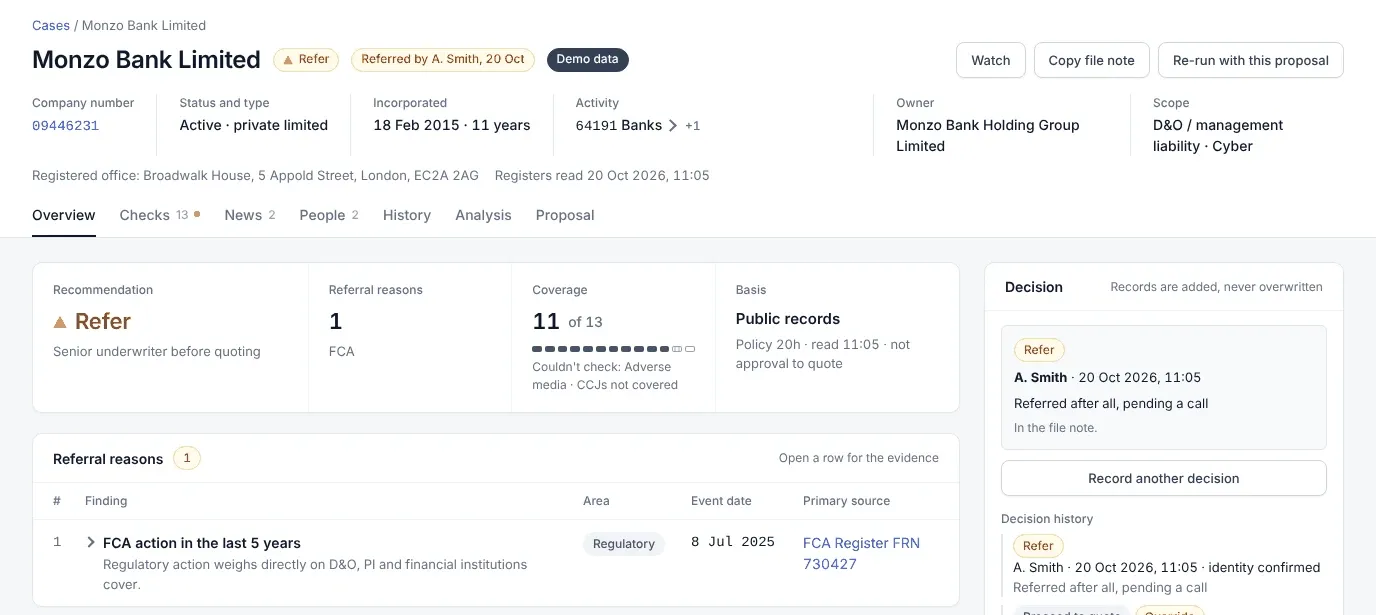
The Pre-Screen answers that question on one screen, with a link to every source. The checks take 5 to 15 seconds, the optional AI review 20 to 60 more, and reading the page about a minute. It recommends a route. A named person decides.
Status: a public demonstration, not a product. The routes and most thresholds are my draft policy from public guidance; nobody with underwriting authority has signed them off.
How it works
Written rules decide. Models read text and explain. Each step is a file you can read.
- Pin down one company. If a name matches several, the underwriter picks, and no decision can be recorded until the company number and address are confirmed against the proposal (
identity.py). - Run thirteen checks (fourteen when the proposal says what the company does) against the public registers: status and filings, insolvency and Gazette notices, charges, directors and their other companies, ownership, sanctions, FCA authorisation, and the news. Each source has its own small client, and a source either returns data or says it failed, never an empty "all clear" (
sources/,checks.py). - Read the news against the company. One model call answers a narrow question: is this article about this legal entity? (
media.py) - Apply the rules. Thresholds are written down and versioned, and they pick one of four routes: Note only, Refer, Outside appetite, or Compliance hold (
rules.py). - Agents on top, through an MCP server. They explain a case and draft questions for the broker. There is no tool for recording a decision, and they can't change the route (
mcp_server.py,agents_v2/). A guardrail checks their drafts and can hold one back; it isn't a guarantee.

Two rules that make it reviewable
"Nothing found" isn't "clear". Every check ends in one of five states: clear, worth reading, flagged, couldn't check, or not applicable. A check is clear only when it saw everything: a source that failed, a list that was cut short or a news result nobody read is "couldn't check". If a critical check couldn't run, the best a case can be is Refer. The lesson behind this rule is Nothing found isn't the same as nothing checked.
No model writes the route. My first attempt let an agent write the risk level, and one bank came out "medium" because that was the schema's default value. That story is told in My AI agent called a fined bank "medium risk". Here the route is copied from the rules into every output, and the agents can only read it.
What works, and what doesn't yet
Works today
- A pre-screen of a real UK company on live public data, usually in 5 to 15 seconds.
- Every gap named on the page and in the file note, with a re-run button.
- Decisions recorded with a reason and a name, added to, never overwritten.
- The same checks as nine MCP tools, locally or over HTTP.
- The core demo runs offline without API keys, on two captured real companies and five invented ones that show each route and failure. AI analysis requires a model connection.
Not yet
- County court judgments aren't checked (paid data); they always show as not covered.
- Registered societies, such as co-operatives, aren't covered: Companies House doesn't hold their directors or owners, so the tool says so and checks nothing.
- HSE and Environment Agency enforcement aren't connected.
- The public demo doesn't search The Gazette, which has refused its server since late October. It's listed as not covered, so a winding-up petition published there before Companies House records it won't show. Local runs search it.
- Most thresholds are drafts from public guidance; someone with underwriting authority needs to sign them off.
- The sanctions screen matches names and dates of birth against the UK list only. It's a pre-screen, not an insurer's sanctions process.
- Large LLPs are slow, and only their first 15 members are checked, which the page says.
- It has been evaluated on nine companies, not on a book of real referral decisions.
Start here
- Before you quote a UK company, know what wasn’t checked: what an underwriter needs before quoting, and how the Pre-Screen answers it.
- Try the UK Company Pre-Screen yourself: browse the nine example cases, ask for a code to run your own companies, or run the core demo locally without API keys.
Try it
The live demo opens nine real example cases, read-only, with no sign-up. To run companies of your own, ask for a demo code from the demo page: five pre-screens and two agent reviews a day. The code is MIT-licensed on GitHub, and its core demo runs offline without API keys. If you underwrite commercial risks and see a gap, message me on LinkedIn.
The notes
- Version 1 let an AI agent decide. Version 2 lets written rules decide.A better model removes the model's excuses. What's left is the design: if a check has no way to say it didn't run, it will be reported as clean.
- Before you quote a UK company, know what wasn’t checkedAn underwriter needs a route and its reasons before quoting a company, plus an honest list of what wasn’t checked. A tool that hides its gaps is worse than none.
- Try the UK Company Pre-Screen yourselfTwo saved cases teach the difference between a check that couldn’t run and a finding on the record. Then screen your own company, or make it fail on purpose.

AI engineer with 14 years across machine learning and applied AI: prompt design, document AI, LLM workflows and the review loops that make them safe to ship. I build real systems and write up what breaks along the way.
Get the next note by email
One short email when something ships or breaks. Free.